
Co-creating Cinema AFFR
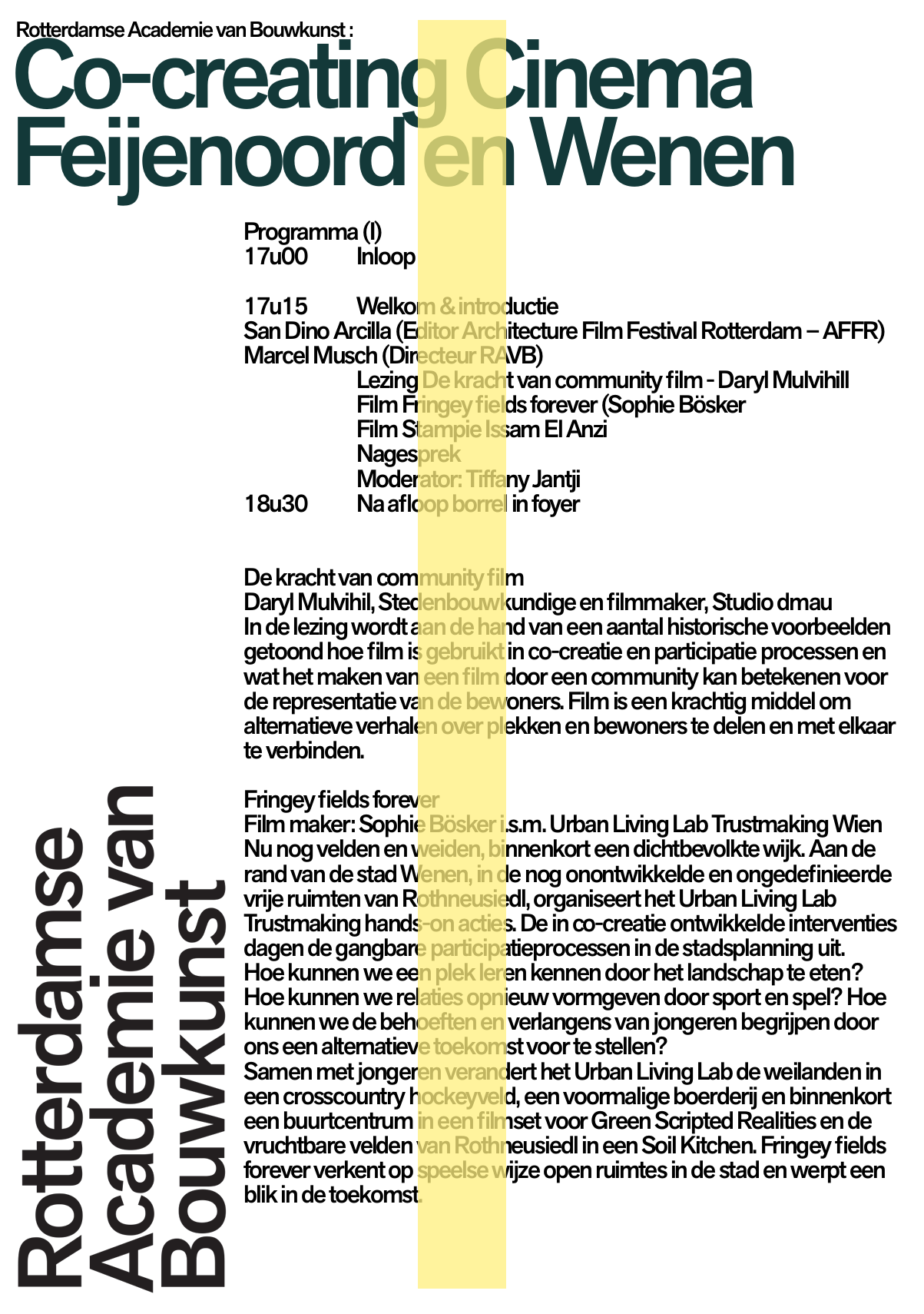
A lecture and film programme at Architecture Film Festival Rotterdam, Lantarenvenster, October 2024.
The Power of Community Film
Cinema is the finished product: large budgets, distribution, the market. Film is something else, a tool, a process, a way of working. Add community to it and the meaning shifts again. Community film is not about the quality of the output. It is about what the act of making does to a group of people, to a place, to a set of relationships. The catalyst of film for conversation for dialog.
The lecture I gave at AFFR in October 2024 traced a short history of this through five examples. The first was the Fogo Process, developed by Colin Low at the National Film Board of Canada in the late 1960s. Over two years, Low filmed the fishing communities of Fogo Island: long, unhurried conversations that were not particularly cinematic. But that was the point. The process became a form of local democracy. Residents on different parts of the island who would never otherwise have spoken to each other saw themselves in each other's footage. The film process, recording, watching, responding became a continuous collective conversation.
From Fogo the lecture moved through a number of key examples from the history of community and participatory film, fragments of each were screened to the audience. Challenge for Change — the NFB programme that supported community film projects across Canada through the 1970s — and One Millionth Tower, where documentary making and placemaking directly converge. Then to Behind the Rent Strike and Ethel Singleton's question, posed directly to camera: whose are the media? And finally the Detroit Narrative Agency, a collective that developed precisely in response to what dominant media had done to their city: took the story back, and put the work of authorship in local hands.
Six things emerge from these examples, or that's how I framed them in the lecture:
Co-creation as catalyst for change;
Multiple perspectives over single-author narratives;
Made with communities rather than for or about them;
Critical of traditional media and representation;
Redefining who creates, how, and why;
Interpreting the world with a focus on justice.
This last point is clearly expressed throughout the screened examples, community film is rarely neutral, it is often an explicit political act of advocacy.
The evening continued with screenings of Fringey Fields Forever (Sophie Bösker, Vienna) and Stampie (Issam El Anzi, Rotterdam), both made as part of the Trustmaking research programme, followed by a panel with filmmakers and residents.