
Waddenbuurt Commons
Value, Use, Strengthen. A competition-winning urban vision for a post-war neighbourhood in Haarlem.
Type: Competition Urban Vision Neighbourhood Transformation
Date: 2020
Client: Panorama Lokaal, College van Rijksadviseurs, Gemeente Haarlem, Pre Wonen
Collaborators: AP+E, Waag - Commons Lab
Panorama Lokaal was a competition run by the Atelier Rijksbouwmeester to find design solutions for the rural-urban fringe — specifically the monofunctional residential neighbourhoods built across the Netherlands in the 1960s, 70s, and 80s. These districts were well-planned for their time: housing for families leaving the dense city, with light, air, and space separated from traffic and industry. They were not planned to change. The studio was selected to develop a plan for the Waddenbuurt at the heart of Haarlem's Schalkwijk district.
The brief came with a given: half the buildings were already on the demolition list. The team refused to start from that premise. Where the conventional logic said clear and rebuild, the design asked a different question: what if the threat of demolition became an opportunity?
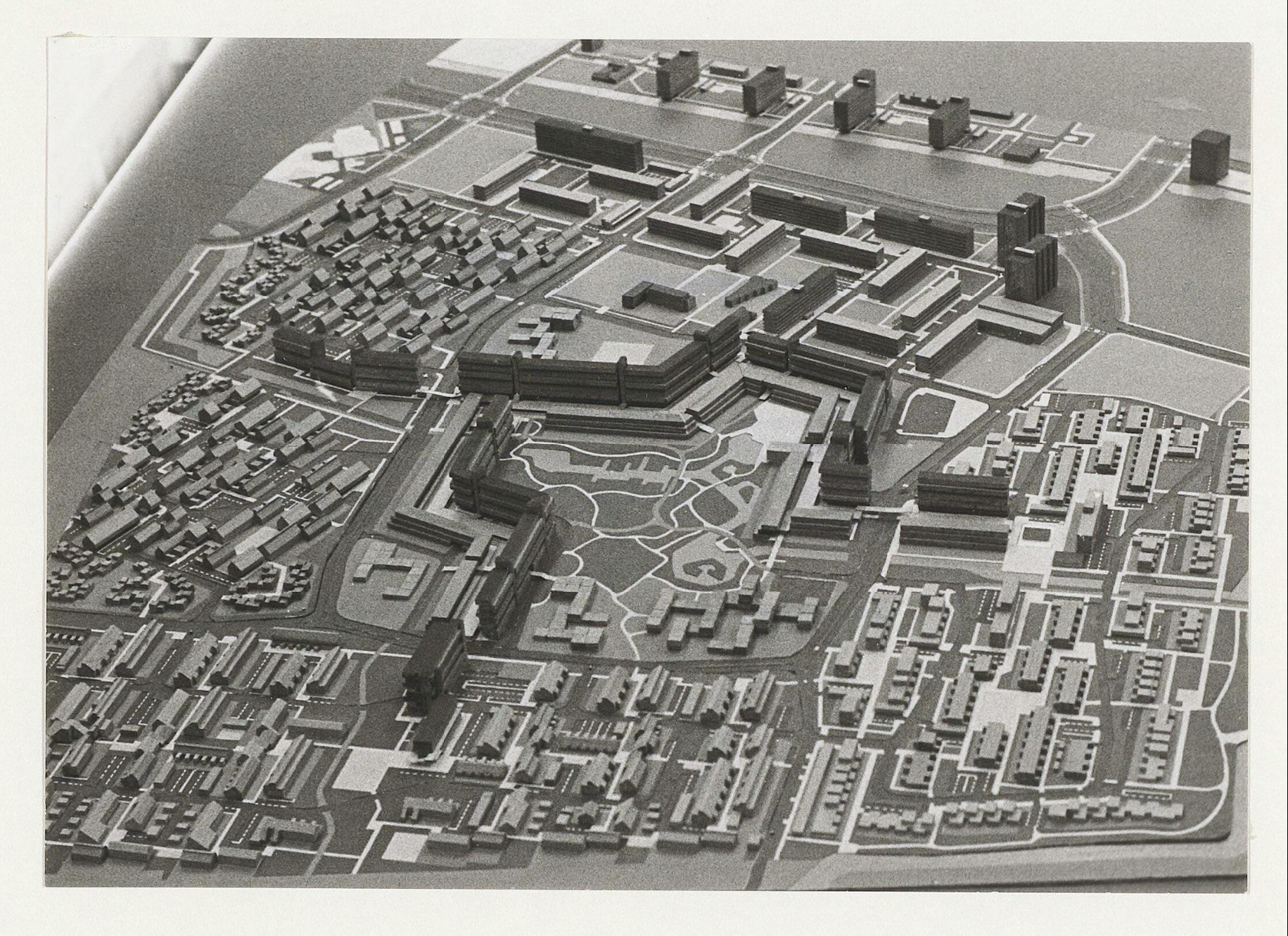

The research process started with observation. The team visited Schalkwijk and the Waddenbuurt several times, and spoke with residents, organisations, and institutions active in the neighbourhood — including the director of the Waddenschool, the Wijkraad, Kunstnest, Pre-Wonen, and community organisations Open Huis and Triple ThreaT. An online survey reached residents across all four sub-neighbourhoods. What emerged was a different story from the one the policy documents told. Residents were proud of their neighbourhood, attached to its open green structure, and invested in its future. The energy and initiative already present in the neighbourhood was the starting point — not the buildings marked for removal.
The design approach is permaculture urbanism: a framework drawn from the principles of permaculture — observe and build on existing quality, create feedback loops, connect rather than separate, value diversity, build social and ecological capital rather than extract financial value. Applied to the Waddenbuurt, this meant taking the qualities already present — the rooted green structure, the open urban layout, the active social fabric — as the foundation, and using them to address the large transition challenges the neighbourhood faces.
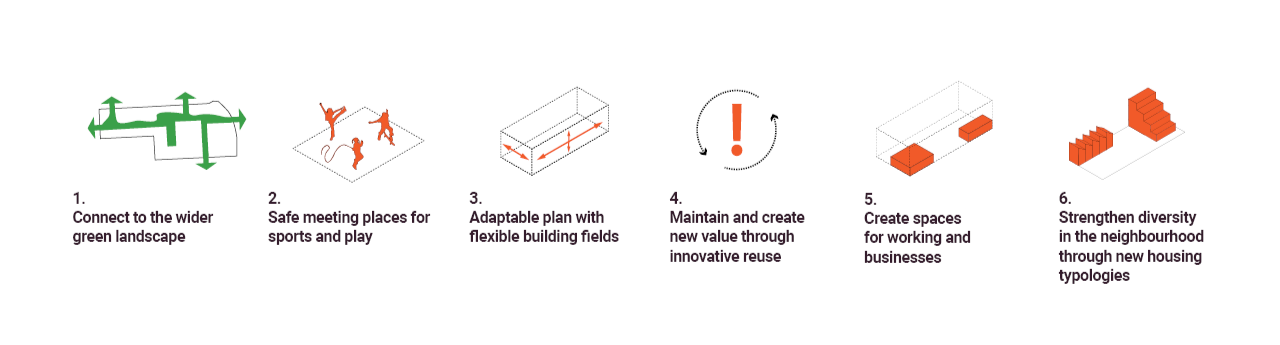
Six strategies were distilled: connect the green edge to the neighbourhood; create safe places for sport, play, and meeting; use the post-war urban structure as a framework for an adaptable plan with flexible building plots; preserve and create new value through innovative reuse of existing buildings; create places where latent entrepreneurship can flourish; and strengthen diversity through new forms of living and ownership.
The first spatial move is connecting to the larger Green Corridor. Schalkwijk sits at the edge of the Haarlemmermeer polder. The layout of the neighbourhood makes no use of that relationship: the green is disconnected internally, and cut off from the landscape beyond. The proposal creates a corridor threading through the Waddenbuurt: climate-adaptive, pedestrian and cyclist priority, designed as the shared backyard of the neighbourhood. A place where different groups can find each other, and where community organisations can operate in the public realm.
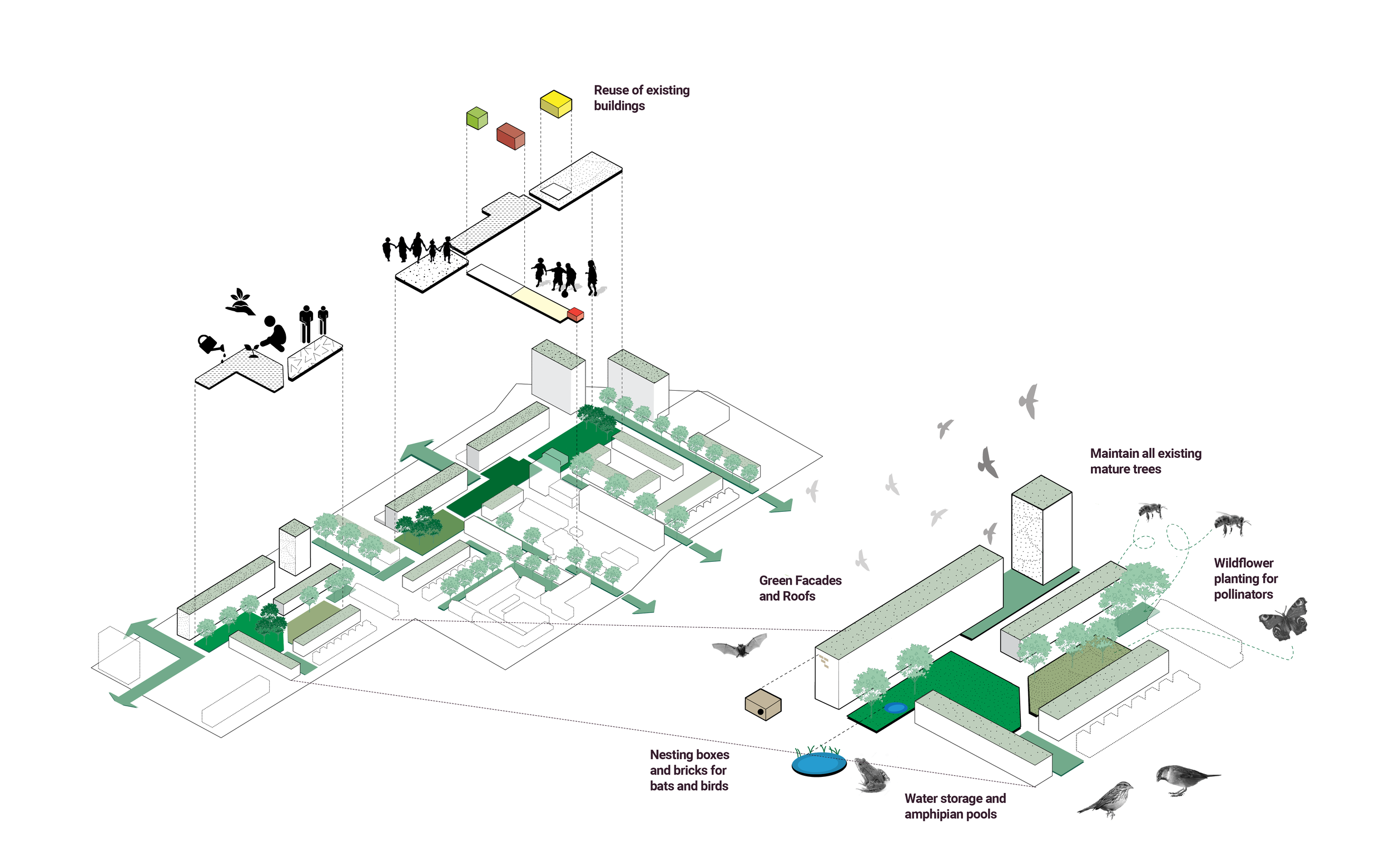
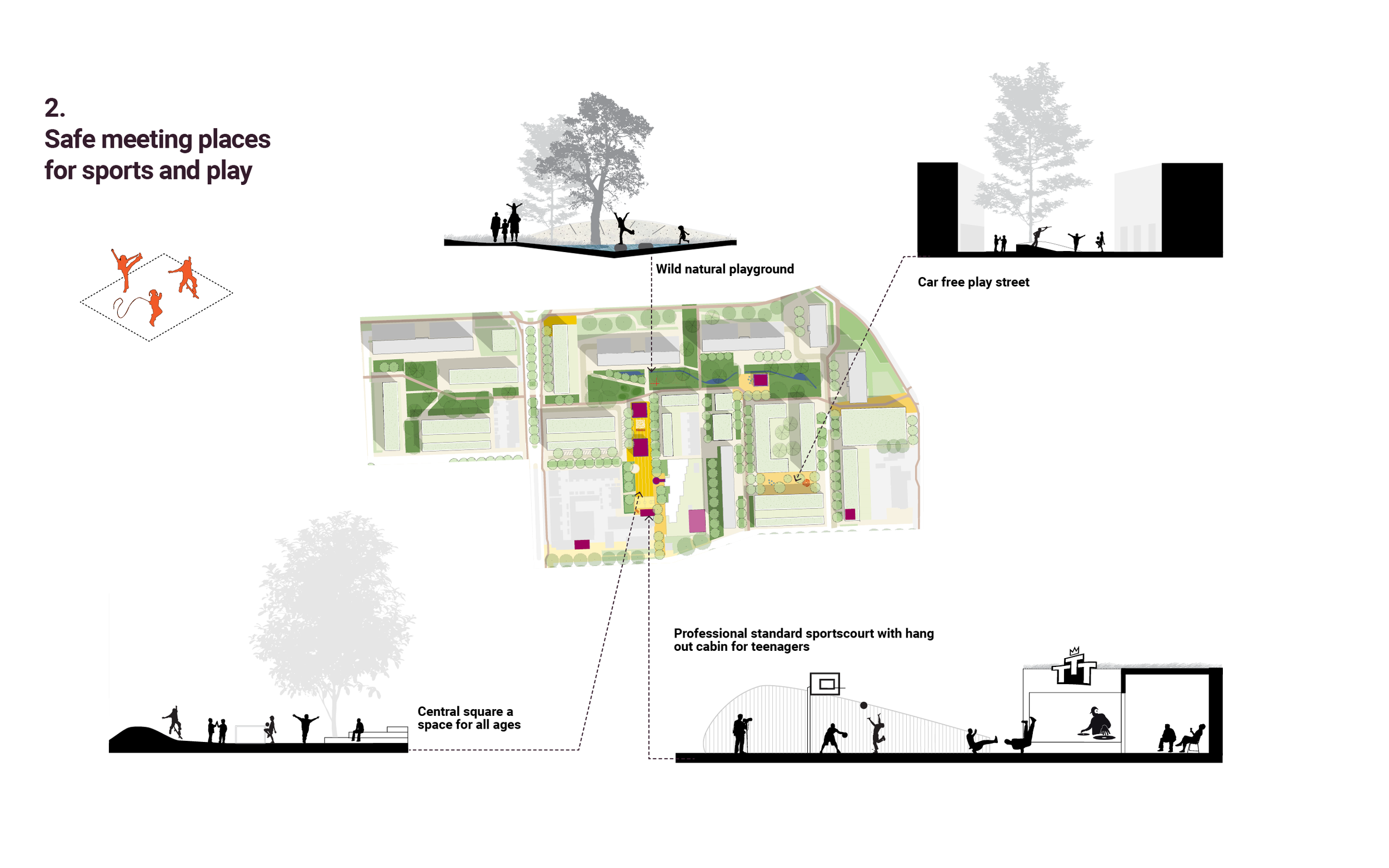
The second move addresses sport and play. Existing play provision in the Waddenbuurt was designed for young children and provided nothing for teenagers — a gap that the survey and conversations made explicit. The proposal distributes a series of play and sport spaces through the neighbourhood, with car-free streets as the primary play surface for young children and a dedicated sports field for teenagers, developed in partnership with the Krajicek Foundation and Triple ThreaT. Safe, age-appropriate, spread across the neighbourhood rather than concentrated in one location.
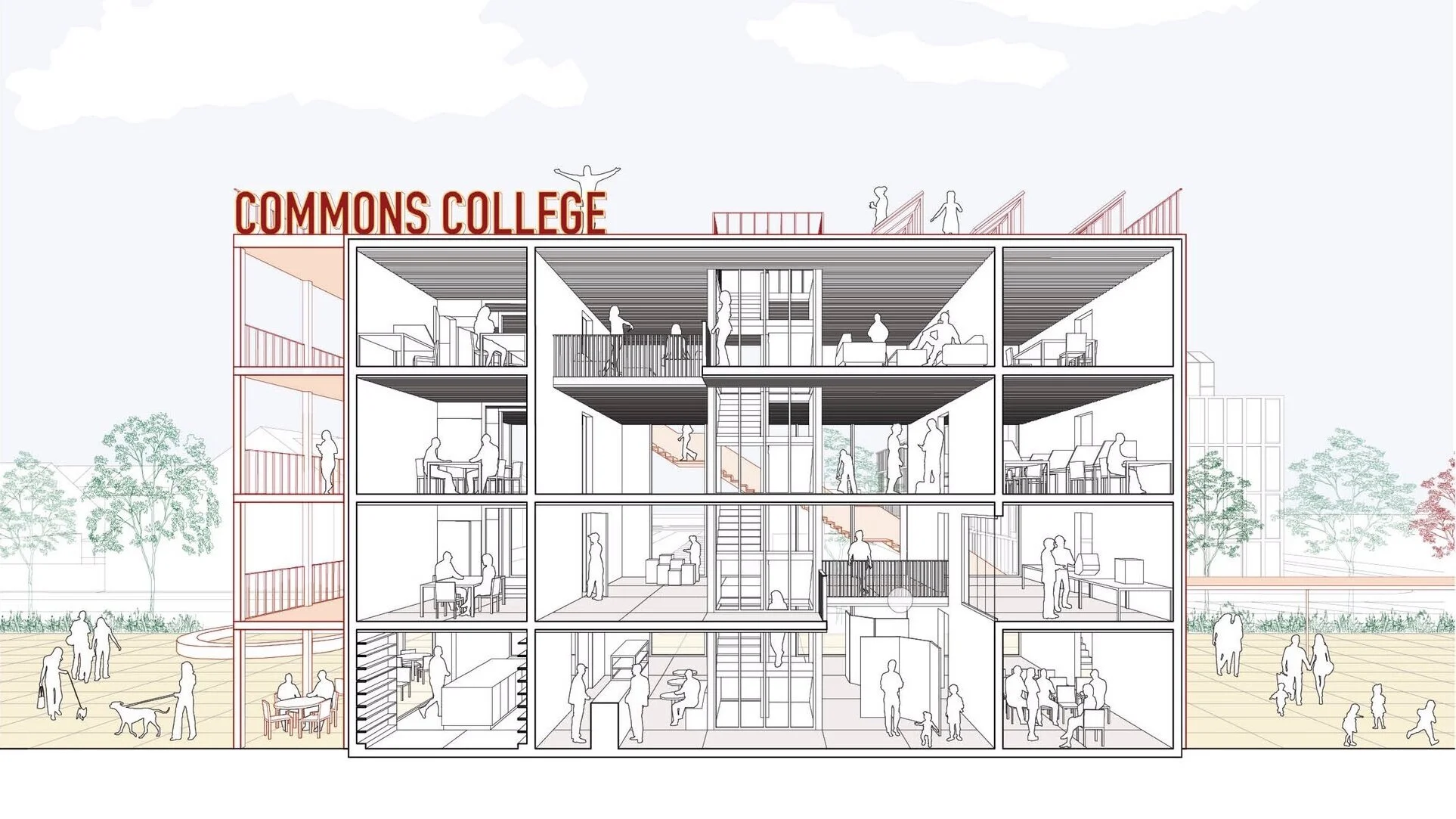
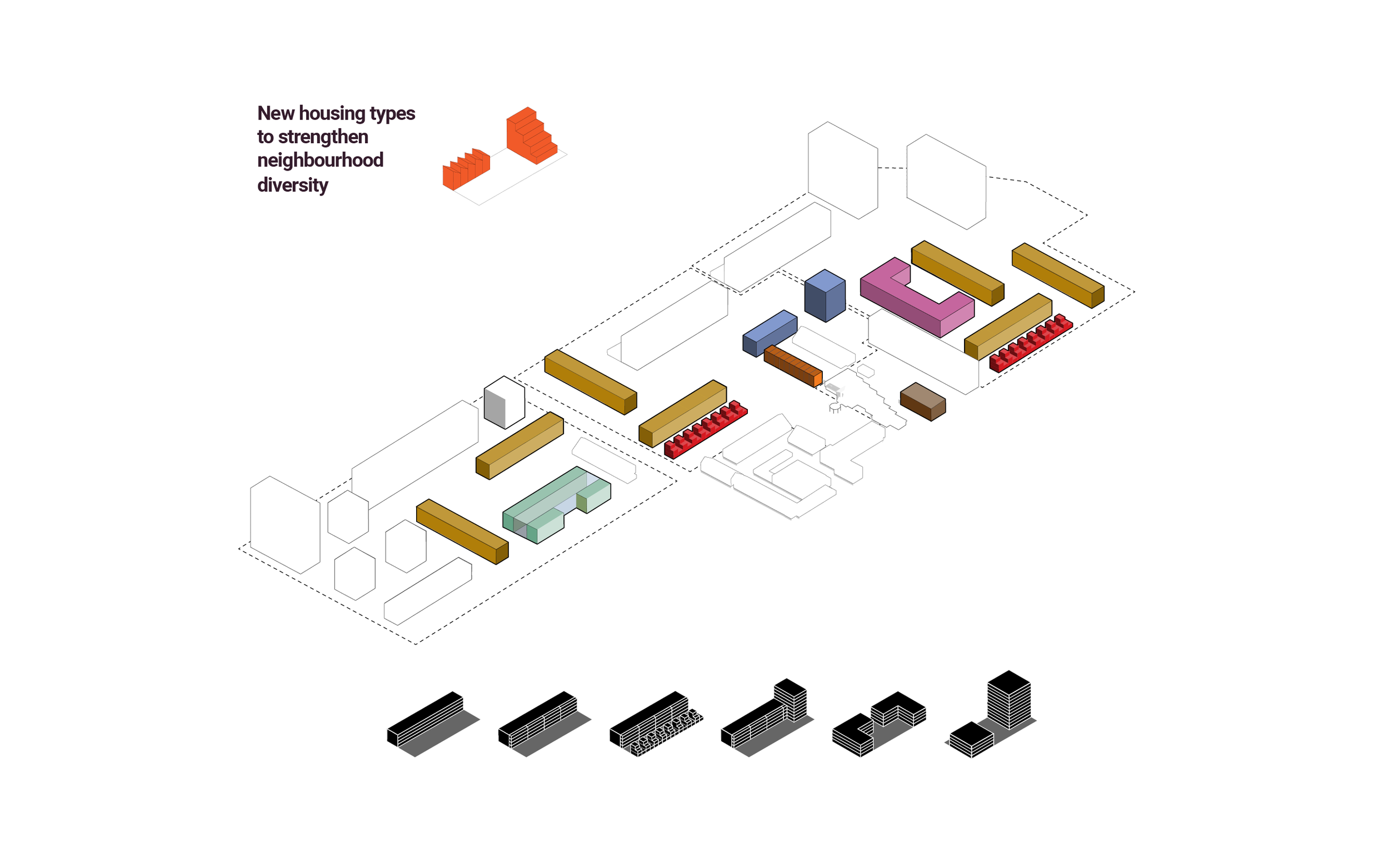
At building scale, the proposal works with the existing housing stock rather than against it. Of the eleven blocks in the Waddenbuurt, seven are renovated and upgraded — adding new facades carried by a lightweight wooden frame, activating the ground floor for housing or workspace, and creating communal roof gardens. Two blocks are partially reused. Only two are fully demolished. The approach is called Value Added Repair: renovation that goes beyond solving technical problems to upgrading the buildings spatially, aesthetically, and socially at the same time. The existing concrete structure and staircases are preserved wherever possible. Lifts are added. The result: better homes, more homes, and a ground floor that opens onto the street.
The strategy scales. Schalkwijk's post-war planning means the portiekflat typology repeats across the district. The team identified 89 other comparable blocks in Schalkwijk. If the same approach were applied across all 100: 800 new front doors, 45 entrepreneurship spaces, 85,000m² of green roofs, 7,000m of façade gardens.
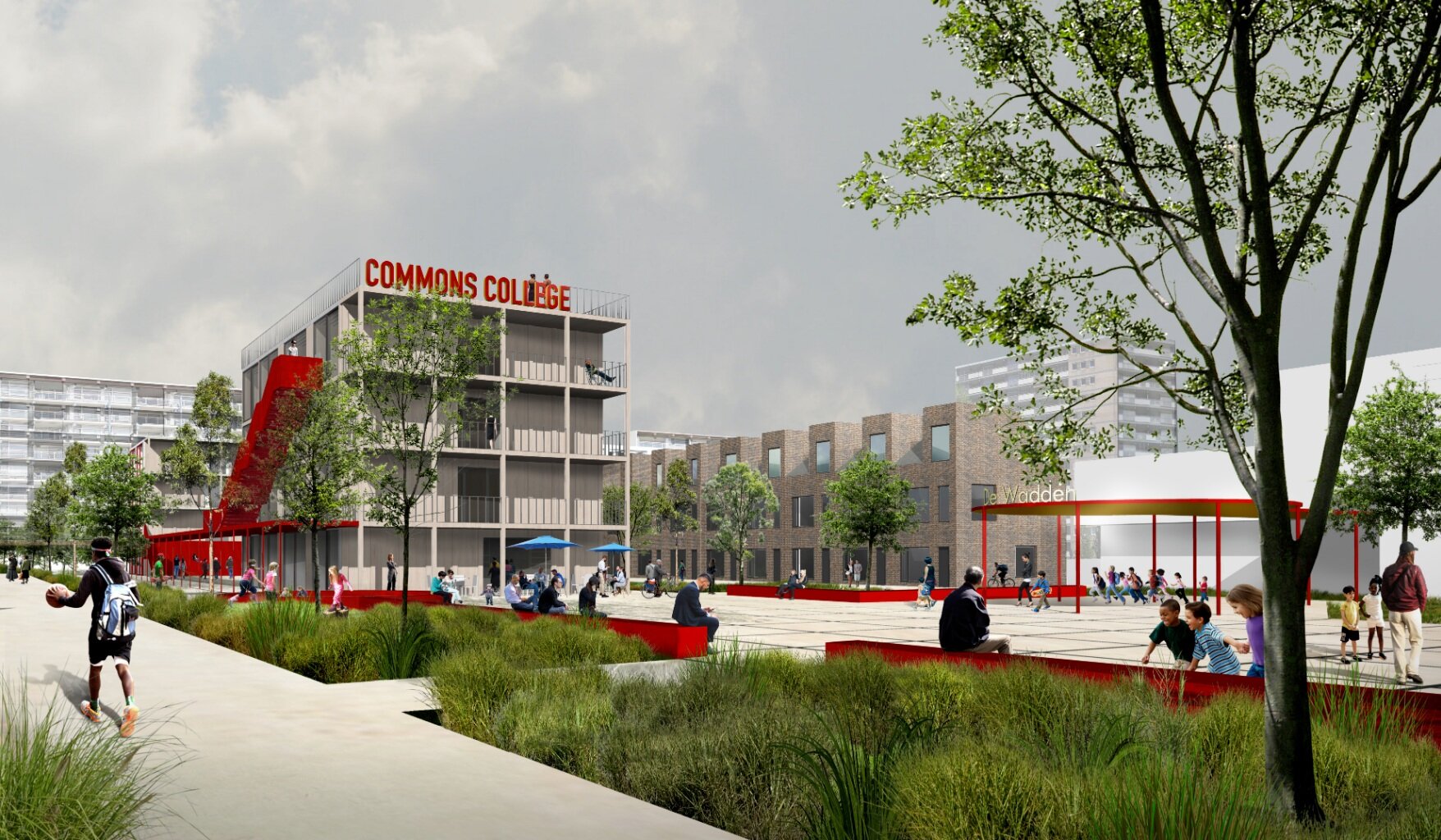
At the centre of the Waddenbuurt, adjacent to the Waddenschool, is the neighbourhood's existing social anchor. The school's director described it this way: "De Waddenschool is een maatschappelijke organisatie met ook nog een school." The Commons College is built around that observation. Housed in one of the reused flats beside the school, it is a neighbourhood hub with a broad educational programme — focused on making, imagining, learning, meeting, and eating. It is organised around three principles: shared ownership, reciprocity, and active participation. No one is only a recipient; everyone is a participant.
The first step is deliberately small: a set of garage boxes adjacent to the future Commons College building are converted into Commons College 1.0 — a workshop, meeting space, and consultation point for the neighbourhood's redevelopment, run with Prewonen, Wijkraad, Kunstnest, Open Huis, and Stichting Samen. This phase can start immediately, before the larger process begins. The studio's experience is that transformation at neighbourhood scale takes years, and without something happening first, trust does not develop.